The buried spacecraft
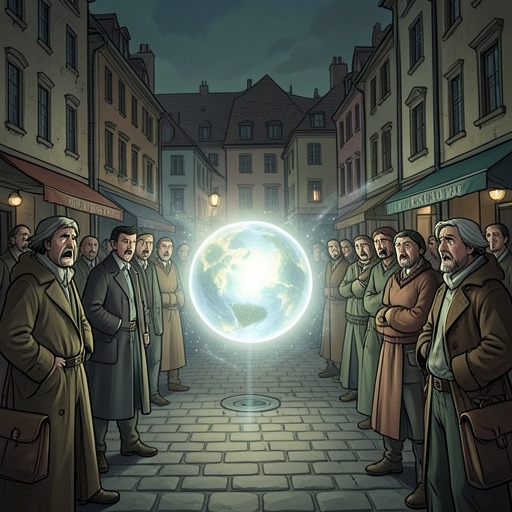
The TommyknockersThe buried spacecraft is the enormous extraterrestrial vessel Roberta “Bobbi” Anderson discovers beneath the forest floor near Haven. Its smooth gray hull first appears as a small metallic gleam, but the excavation reveals a structure on a scale that overwhelms ordinary measures; as the novel progresses, the ship’s buried mass shapes the town’s strange boundary, draws people into dangerous acts of construction, and becomes the tilted center of the final confrontation.## Discovery and RecognitionThe discovery begins with an accidental stumble. After falling in the woods, Anderson sees a gleam of metal rather than the rock or fallen tree she expected. She runs a finger over it and blows away the black forest dirt: a small exposed surface, at first no more than an unexplained obstruction in the ground. Its importance emerges through work. As Anderson digs, she makes orderly piles of earth and rock along a fifteen-foot trench, eventually exposing an object that has already emerged several feet above the trench floor. The metal is only a sliver of something titanic, and she cannot identify its composition with confidence.The first act of recognition is visual and tentative. Studying a sketch, Anderson notices that the supposed plate has a curve; the shape suggests a hull, glassy smooth and without rivets. When she uses a compass to trace that curve, its sweep implies a circumference of at least three hundred yards. The measurement is an estimate, not a complete survey, but it overturns the scale implied by the small patch she first uncovered. Her conclusion is not that she has found an unusually large machine or a buried terrestrial structure: the object in the earth is a ship from space. That certainty arrives alongside fear, awe, and excitement, while the possibility of being mistaken remains psychologically present.### Excavation and Physical PresenceRoughly twenty minutes after Anderson returns to the work, the exposed section of gray hull has become impossible to dismiss as fantasy. She believes she has freed only a tiny part of an extraterrestrial spacecraft. The material is solid and tool-like in its resistance, while its smooth surface denies the idea that it is merely a dream or vaporous speculation. The physical certainty of the metal sharpens, rather than resolves, the mystery: she can touch the hull, but she still does not know the vessel’s origin, purpose, or age.The early digging also coincides with evidence of harm around the object. On the slope below the excavation, Anderson encounters five dead birds: a sparrow, two crows, a bluejay, and a scarlet tanager. They have no visible marks, and there are no flies around them. The novel does not use this sighting to explain the deaths, but its placement beside the newly exposed hull makes the excavation’s surroundings feel hazardous before the ship itself is understood. Anderson continues down into the muddy trench, where the smooth gray metal disappears into the earth.### The Ship and Haven’s BoundaryAs the excavation grows, the ship’s presence reaches beyond the forest. During an eight-day hot spell from July 12 through July 19, the sound of Anderson’s old truck, rebuilt as a digging machine, carries clearly into Haven Village. People know that something important is happening at the old Frank Garrick place, but they do not speak openly about it. The secrecy surrounding the work coincides with the town’s spreading transformation, as residents begin to “become” and to build devices whose consequences can be dangerous. The ship is not shown as the sole cause of every local event, but the excavation and Haven’s altered life are presented as interwoven developments.At the same time, the idea of a barrier around Haven moves from speculation to bodily experience. Ruth McCausland initially rejects the notion that the town has been enclosed like an ant farm beneath a bowl. Yet when she tries to walk out, the air grows springy and resistant: it stretches the skin of her face, presses against her body, and makes forward movement impossible. She feels herself pushed backward by an invisible boundary. The scene gives concrete force to the earlier, seemingly absurd image of enclosure. The ship remains underground, but the novel’s geography has become a trap: crossing the town’s border is no longer simply a matter of taking a road.### Scale, Machinery, and the Growing ExcavationBy the time Ev Hillman and Butch Dugan approach the site, the excavation has become a major operation. A ragged slash extends more than three hundred yards from side to side and reaches sixty feet across at its widest point. Anderson’s battered truck stands near a modified payloader with a giant screwdriver-shaped nose; a lean-to holds tools, including a chainfall and a chipper, beside gasoline cans and a drum marked DIESEL. A heap of wet sawdust lies below the chipper’s exhaust. Hillman recognizes the work for what it is: not logging, but excavation.Ninety feet of polished silver-gray metal now project from the hillside into the sunlight, with at least another forty feet visible farther into the cut. The exposed length makes the vessel’s scale newly legible without making it comprehensible. The people and machinery around it seem almost provisional, arranged at the edge of an object that is still mostly underground. Its huge curved surface has become an unavoidable spectacle: Hillman’s attention keeps returning to it even as he takes in the tools and the altered landscape.### Interior, Final Image, and SignificanceWhen James Eric Gardener looks inside, the ship’s interior is as disorienting as its exterior is immense. He finds himself in a corridor that is perfectly round except for a flat walkway halfway up one side. The arrangement seems wrong until he understands that the corridor, walkway, and ship are all canted because the vessel lies at an angle. Soft light comes from featureless walls. The interior does not offer the reassuring legibility of a familiar craft; even the basic orientation of floor and passage has been displaced by the ship’s position.The novel’s final image of the vessel preserves that dislocation. At the clearing, Tommyknockers stand looking from the canted plane of the ship to Dick Allison and back again, while a fire advances and smoke begins to fill the space. More arrive, but they do not move; the others who have returned to the village seem to share the same waiting through the observers’ eyes. The ship is at once a visible landmark and the focus of a collective, arrested attention. By bringing the buried hull into the open while fire closes around the clearing, the ending makes the vessel’s emergence inseparable from the collapse of the world organized around it. Its discovery began with a glint beneath dirt; its final presence commands the gaze of a crowd that has lost the capacity to act.